The Boardroom
2026 Edition
Research Briefing · For Counselors, Parents & Ambitious Students

The New Arithmetic
of Ambition

Getting in has never been harder — and getting in was never the hard part. The numbers behind elite admissions, elite hiring, and the widening gap between a credential and a career.

3.6%admitted to Harvard, Class of 2028
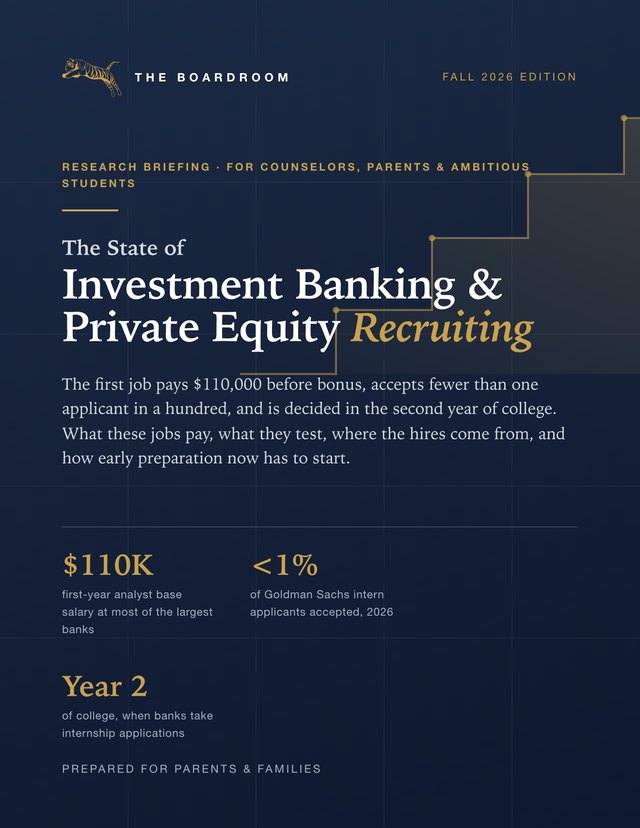
0.7%accepted at Goldman Sachs, 2025
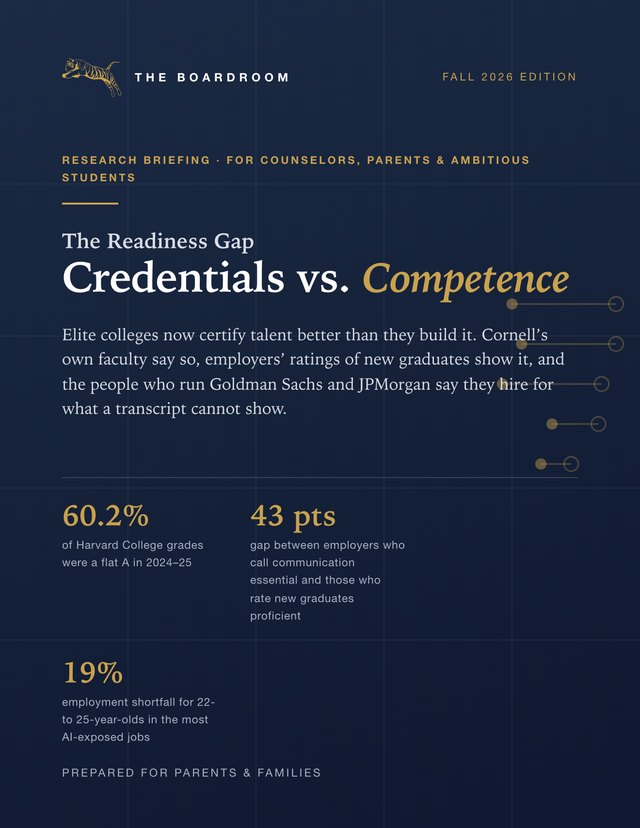
35ptsstudent–employer readiness gap
Prepared for parents & families
The Boardroom · 2026

Contents

—
At a GlanceThe briefing in six numbers
3
I
The Front Door Keeps NarrowingAdmit rates, applicant volume, and yield
4
II
The Back Door Is Even SmallerHow selective elite employers have become
6
III
Selectivity CompoundsWhy the second gate is narrower than the first
8
IV
Over-Credentialed, Under-PreparedThe gap between the diploma and the job
10
V
The Boardroom Closes the GapTeaching what the transcript leaves out
13
Methodology & Sources
16
Summary

At a Glance

Two selective gates now stand between an ambitious student and an elite career — and the credential that clears the first does surprisingly little to clear the second. Six numbers frame the briefing.

7.4%
Average admit rate at the most competitive colleges in 2017 — down from 18% in 2002, as applications more than doubled.
Pew Research Center
10.1M
Common App applications in 2024–25 — the first time above ten million, up 161% in a decade.
Common Application
0.7%
Goldman Sachs' summer-analyst acceptance rate in 2025 — its third straight year below one percent.
Fortune · eFinancialCareers
~1%
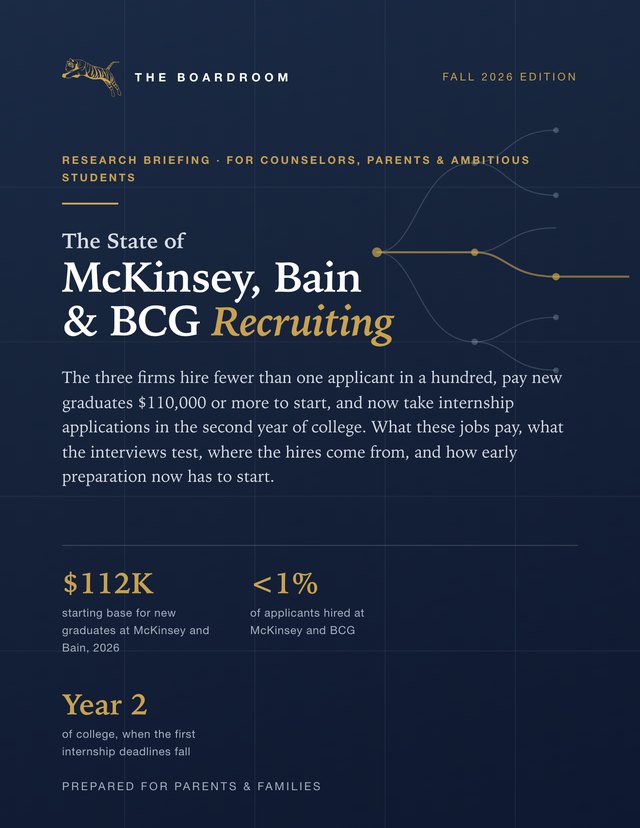
Share of roughly one million yearly applicants that McKinsey hires.
The Economist · Business Insider
24
Universities that supply about 73% of elite consulting's U.S. entry-level hires — out of 175+ that place anyone.
CaseCoach
35pts
Gap between students (66%) and employers (31%) on whether new graduates are proficient leaders.
NACE 2024 · Job Outlook 2025
Part I

The Front Door Keeps Narrowing

Record applicant volumes and record-low admit rates mean the college gate has never been tighter.

3.6%Harvard's admit rate for the Class of 2028 — down from 10.7% two decades ago
18% → 7.4%Average admit rate at the most competitive colleges, 2002 to 2017, as applications more than doubled.1

Start with what parents already feel: the front door is narrowing. Across America's most competitive colleges, the average admission rate fell from 18% in 2002 to 7.4% in 2017 — even as the number of applications more than doubled.1 At the very top the squeeze is sharper. Harvard admitted 10.7% of applicants to the Class of 2005; for the Class of 2028 it admitted just 3.6%, from a pool that has now topped 50,000 for four straight years.2 Stanford's rate more than halved over the same span, to 3.6%.3

The pressure is systemic, not anecdotal. In 2024–25, applications through the Common Application crossed ten million for the first time — up 161% in a decade — as roughly 1.5 million students each applied to a record 6.8 schools.4 Individual campuses feel it too: NYU drew more than 120,000 applications this year, the most of any private university in the country.5 And because more of the students admitted to the very top now enroll — Harvard's yield has reached about 84% — the seats that remain in play grow scarcer still.2

Exhibit 1
Admit rates, then → now
ThenNow
The doors have closed by roughly half — or more. At the most competitive colleges overall, and at the very top, the share of applicants admitted has fallen sharply in under two decades.
Source: Pew Research Center (2002, 2017); The Harvard Crimson, Class of 2005 & 2028; Stanford Common Data Set / The Stanford Daily.
Exhibit 2
Applications keep climbing
More students, applying to more schools. Total first-year applications through the Common App surpassed 10 million for the first time in 2024–25 — up 161% in a decade — spread across ~1.5 million applicants sending a record 6.8 applications each.
Source: Common Application, End-of-Season Reports. ‡ 2015–16 shown from the reported +161% growth.
Part II

The Back Door Is Even Smaller

The most sought-after employers now accept a fraction of one percent — well below any college.

0.7%Goldman Sachs' summer-analyst acceptance rate — ~5× tougher than Harvard
~5×How much harder a Goldman summer seat (0.7%) is to win than a place at Harvard (3.6%).

If admission is the gate parents watch, employment is the one that ultimately matters — and it is far narrower. In 2025, Goldman Sachs received more than 360,000 applications for roughly 2,600 summer-analyst seats: an acceptance rate of 0.7%, its third consecutive year below one percent, and down from 2% a decade earlier.6 McKinsey fields on the order of a million applications a year and hires about 1% of them.7

Put plainly: a summer seat at Goldman is roughly five times harder to win than a place at Harvard. The most selective employers now admit a smaller share of their applicants than any college in the country.

Exhibit 3
Elite hiring is tightening — fast
Goldman's summer-analyst acceptance rate has fallen from 2.0% to 0.72% and has stayed below 1% for three years running — as applications tripled since 2018 to more than 360,000 for ~2,600 seats (about 138 candidates per place).
Source: eFinancialCareers (Jun 2025); Fortune; CNBC. Rates: 2013, 2022, 2024, 2025.
Exhibit 4
Narrower than any college gate
Elite employerElite college
The job gate sits below the college gate. A Goldman summer seat (0.7%) is several times more selective than admission to Harvard or Stanford (3.6% each). McKinsey's ~1% is a widely reported approximation; the college figures are disclosed rates.
Source: Fortune / eFinancialCareers (Goldman, 2025); Business Insider / The Economist (McKinsey); The Harvard Crimson; Stanford CDS.
Part III

Selectivity Compounds

Every elite school feeds the same few firms — so the second gate is narrower than the first.

24schools supply ~73% of elite consulting's U.S. entry hires
70%+of each Harvard senior class typically applies to banking or consulting.8

Why is the second gate narrower than the first? Because the two are connected. A top college draws from a national pool of applicants; a top firm draws from the graduates of every top college at once — then hires only a few thousand of them.

The concentration is well documented. Elite banks and consulting firms recruit from a short list of "target" schools: one analysis of some 12,000 investment-banking analysts identified just 15.9 Across McKinsey, Bain, and BCG's U.S. offices, hires came from more than 175 universities — yet 24 of them supplied roughly three-quarters of all pre-experience hires, with a single pair, Penn and Harvard, accounting for nearly one in five.10 Independent surveys of working consultants show the same concentration.11

The effect compounds. The strongest students of every elite school are funneled into competition for the same scarce seats — so selectivity does not reset at graduation. It intensifies.

Exhibit 5
Two gates, multiplied
A diploma is the ticket to the tournament, not the prize. Apply a top college's real 3.6% admit rate, then an elite firm's real 0.7% hire rate, to a round cohort of 100,000 ambitious students, and about 25 clear both gates.
Illustrative: the 100,000 cohort is a round figure; both rates are disclosed (The Harvard Crimson; Fortune). Bar widths shown on a log scale.
Exhibit 6
A few dozen schools, one national contest
Just 24 universities supply ~73% of elite consulting's U.S. entry hires — out of 175+ that place anyone at all. Penn and Harvard alone account for 18%.
Source: CaseCoach analysis of McKinsey, Bain & BCG U.S. pre-experience hires.
Part IV

Over-Credentialed, Under-Prepared

Employers say today's graduates arrive credentialed but unready for the actual work — and a major new study agrees.

31%of employers rate new grads proficient leaders — vs 66% of students

Here is the paradox. Students are clearing higher and higher bars to earn their credentials — and employers say they are arriving unprepared for the work itself. Four in ten business leaders now say recent graduates are not ready for the workforce.17

In September 2026, a year-long Cornell University study drawing on more than 6,000 students, faculty, alumni, and employers reported "jarring" skepticism among employers about whether today's graduates can navigate uncertainty, absorb criticism, recover from setbacks, and work with people they disagree with. A transcript, employers noted, measures none of that.12

The national data quantify the gap — and it begins with the institutions. In McKinsey's global Education to Employment study, 72% of educators judged their graduates ready for work; only 42% of employers agreed, with graduates themselves falling in between. The people closest to the teaching are the most convinced it worked — and the furthest from the hiring.14

“American graduates, whatever their specialized knowledge, arrive in the workplace without…” the professional and relational skills employers most need — the capacity to navigate uncertainty, absorb criticism, and work with those they disagree with.

— Report of the Committee on the Future of the American University, Cornell University, 2026
Exhibit 7
What educators believe — and what employers see
The people teaching students are far more confident they're ready than the people hiring them. Educators call new graduates work-ready nearly twice as often as employers do — a 30-point gap — with graduates themselves caught in the middle.
Source: McKinsey & Company, "Education to Employment: Designing a System That Works" — share saying newly educated workers are ready for work.

And it is not new. The same disconnect shows up across a decade of independent studies:

2015 · AAC&U
66% vs 26%
of students call grads well-prepared in critical thinking — versus just 26% of employers.
Falling Short?15
2024 · NACE
80% vs 50%
of students vs employers rate new grads proficient in professionalism — a 30-point gap.
Student Survey / Job Outlook13
2025 · Cengage
89% / 48%
of educators say students are ready — yet 48% of grads feel unprepared to even apply for entry-level jobs.
Employability Report16

The through-line is consistent: students optimize for the signal — grades and credentials — while the judgment, communication, and composure that employers actually reward go largely untaught. Over-credentialed, and under-prepared.

Part V

The Boardroom Closes the Gap

The preparation schools skip — how real companies run, and how real decisions actually get made.

The case methodReal executive decisions, defended out loud

This is the gap The Boardroom was built to close. The Boardroom teaches through the case method — the approach used in the world's leading graduate business schools, adapted for ambitious younger students.

In each session, students step into a real decision an executive actually faced. They read the numbers, weigh the trade-offs, choose a course of action, and defend it aloud to the room — where peers and instructors push back. It is deliberate practice in exactly what a transcript omits and employers prize: not the recall a test rewards, but the judgment a career demands.

Section 5.1Built to close the readiness gap

Each element of a session is designed to develop a specific capacity that employers — and the Cornell report — say graduates lack. The gaps are not incidental. The room is built around them.

Judgment under uncertainty

Make the call with incomplete information

Real cases rarely have a clean answer. Students learn to reason under ambiguity, commit to a recommendation, and own it.

Closes the widest gap — leadership: 66% of students vs 31% of employers.
Persuasive communication

Defend a recommendation, out loud

Every session ends with a position delivered to the room and pressure-tested in real time — the skill interviews and jobs are built around.

Communication gap: 78% of students vs 54% of employers.
Composure under challenge

Be questioned — and respond well

Being challenged by peers and faculty, and answering with poise, is precisely the capacity the Cornell report found employers doubt.

Absorbing criticism & recovering from setbacks — named by employers as missing.
Reading the business

See how decisions actually get made

Financials, incentives, and trade-offs — the machinery behind a company's choices, made legible before a student ever sets foot in the room.

Critical thinking gap: 81% of students vs 56% of employers.

Section 5.2How the Boardroom compares

Families weigh many summer and enrichment options. Most are built to add a credential, broaden exposure, or raise a score. Few are built to develop decision-making itself. Here is what each path is designed to develop.

Exhibit 8
What each path is built to develop
  College
residential
program
Online
self-paced
course
Private tutoring
& test prep
The BoardroomCase method
Practice making real business decisions◐——●
Defend a recommendation out loud, under challenge◐——●
Reason through open-ended problems with no answer key◐——●
See how companies actually operate and decide◐◐—●
Small cohort with direct expert feedback——●●
Built on the case method (top graduate-school pedagogy)———●
●  Built to develop it◐  Partly / varies by program—  Not typically
Other paths add a line to the résumé; the case method builds the judgment behind it. A residential program broadens exposure and tutoring sharpens a score — but only deliberate practice in real decisions develops the capacities employers say are missing.
Reflects how each format is typically designed; individual programs vary. Comparison by The Boardroom.
Reference

Methodology & Sources

About this briefing

Every figure in this report is drawn from a named public source and was independently verified against primary or reputable secondary reporting. Where a figure is an approximation or an illustration, it is labeled as such on the exhibit. Admission and acceptance rates vary by year and program; the rates and volumes shown reflect the most recent data available as of September 2026.

The Boardroom is an independent education program and is not affiliated with, endorsed by, or sponsored by any university, company, or organization named in this briefing; such names are referenced solely to characterize the public landscape of admissions and hiring. The compounding-funnel illustration (Exhibit 5) applies real, disclosed admission and hiring rates to a round, illustrative cohort of 100,000 students to convey scale, and is not a claim about any specific group of students.

Sources & Notes

  1. Pew Research Center, “A majority of U.S. colleges admit most students who apply” (Apr 2019): average admission rate at the most competitive colleges fell from 18% (2002) to 7.4% (2017); application volume more than doubled.
  2. The Harvard Crimson, admissions statistics — Class of 2005 (10.7%; 19,009 applicants) and Class of 2028 (3.59%; 1,937 of 54,008; fourth straight year above 50,000 applications; yield ~84%).
  3. Stanford University Common Data Set 2024–25 (3.6%; 2,067 admitted); The Stanford Daily (Class of 2016, 6.6%).
  4. Common Application, End-of-Season Report 2024–25: 10,193,579 first-year applications (first time above 10M; +161% since 2015–16; +8% year-over-year); 1,498,199 distinct applicants; 6.80 applications per applicant.
  5. New York University, Class of 2029 admissions release; Washington Square News — 120,633 first-year applications, most of any private U.S. university.
  6. eFinancialCareers (18 Jun 2025) and Fortune / Fox Business / CNBC: Goldman Sachs summer-analyst applications 236,000 (2022) → 315,126 (2024) → 360,000+ (2025), ~2,600 seats; acceptance 2.0% (2013), 1.27% (2022), 0.8% (2024), 0.72% (2025); sub-1% three years running.
  7. The Economist, “Rethinking McKinsey” (2019): 800,000 applicants for 8,000 jobs in 2018; Business Insider / Fortune (2024–25): ~1 million applications a year, ~1% hired.
  8. Lauren A. Rivera, Pedigree: How Elite Students Get Elite Jobs, and “Firms Are Wasting Millions Recruiting on Only a Few Campuses,” Harvard Business Review (2015); Nicholas Lemann / The New Yorker (70%+ of Harvard seniors apply to banking or consulting).
  9. Peak Frameworks, investment-banking target-school analysis of ~12,000 analysts (2008–2023 graduates): 15 “target” schools nationwide.
  10. CaseCoach, U.S. pre-experience hiring at McKinsey, Bain & BCG: hires from 175+ universities, but 24 supply ~73%; Penn 11%, Harvard 7%.
  11. Wall Street Oasis, 2022 Consulting Industry Report (via Poets&Quants): heavy feeder-school concentration among 1,577 consultants.
  12. Cornell University, Report of the Committee on the Future of the American University (released 22 Sep 2026); Cornell Chronicle. Drew on 6,000+ stakeholders; documented “jarring” employer skepticism. (“Over-credentialed, under-prepared” is this briefing's phrasing.)
  13. National Association of Colleges and Employers (NACE), 2024 Student Survey & Job Outlook 2025 — “% rating new grads very/extremely proficient”: Leadership 66% vs 31%; Professionalism 79.7% vs 50.3%; Critical Thinking 80.8% vs 55.9%; Communication 78.1% vs 53.5%; Career & Self-Development 61.5% vs 43.2%.
  14. McKinsey & Company, “Education to Employment: Designing a System That Works” (2012/2013): 72% of education providers vs 42% of employers say graduates are prepared for work.
  15. AAC&U / Hart Research Associates, “Falling Short? College Learning and Career Success” (2015): employers vs students well-prepared — critical thinking 26% vs 66%; written communication 27% vs 65%.
  16. Cengage Group, 2025 Employability Report: 89% of educators believe students are workforce-ready; 48% of graduates feel unprepared to apply for entry-level jobs.
  17. Intelligent.com (2023): 40% of business leaders say recent graduates are unprepared for the workforce.

© 2026 The Boardroom. This briefing is provided for informational purposes for prospective families. Figures reflect public sources cited above as of September 2026.

The Boardroom Research

More briefings

All research →

The Boardroom

A transcript proves a student can be taught.
The Boardroom proves they can decide.

The credential clears the first gate. Preparation is what carries a student through every gate after it — the interview, the first job, and the rooms where consequential decisions get made.
Explore The Boardroom →Apply for Boston 2027 →
The Boardroom · For Counselors, Parents & Ambitious Students2026 Edition