The Boardroom
Fall 2026 Edition
Research Briefing · For Counselors, Parents & Ambitious Students

The Readiness GapCredentials vs. Competence

Elite colleges now certify talent better than they build it. Cornell’s own faculty say so, employers’ ratings of new graduates show it, and the people who run Goldman Sachs and JPMorgan say they hire for what a transcript cannot show.

60.2%of Harvard College grades were a flat A in 2024–25
43 ptsgap between employers who call communication essential and those who rate new graduates proficient
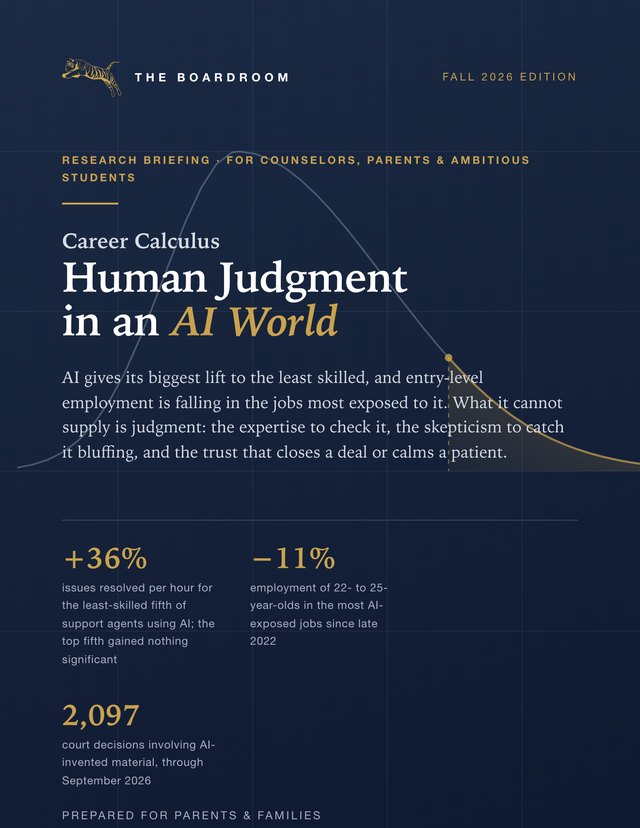
19%employment shortfall for 22- to 25-year-olds in the most AI-exposed jobs
Prepared for parents & families
The Boardroom · Fall 2026

Contents

Summary

At a Glance

Elite colleges have become better at certifying talent than at building it. Grades no longer separate students, employers rate new graduates weakest in the skills they value most, and AI is thinning the entry-level jobs where those skills were once learned.

60.2%
Share of Harvard College grades that were a flat A in 2024–25, up from 24% in 2005.
Harvard College
79%
Share of Yale College grades that were an A or A− in 2022–23. In 1963 the share was 10%.
Yale University
43pts
Gap between the 96% of employers who call communication essential and the 54% who rate new graduates proficient in it.
NACE · Job Outlook 2025
0.05
Observed correlation between college grades and job performance six or more years after graduation. Zero means no relationship.
Roth et al. · Journal of Applied Psychology
<1 in 700
Share of hires that changed when large employers dropped degree requirements from job postings.
Burning Glass Institute · HBS
5.7%
Unemployment rate of recent college graduates in June 2026, above the 4.1% rate for all workers.
Federal Reserve Bank of New York
Reading this briefing

A Short Glossary

These are the terms this briefing uses, in plain English.

Credential
Proof that a student met a standard: a degree, a grade, a certificate. It records completion, not what the holder can do.
Competence
A capacity someone can show at work, such as reasoning through an ambiguous problem or persuading a skeptical audience.
Signaling
The economists’ term for a credential’s value as evidence of traits employers want, apart from anything the course of study taught.
Grade inflation
A rise in average grades without a matching rise in achievement. When most grades are A’s, grades stop separating students.
Transactional education
Cornell’s term for college as an exchange of tuition for a credential. Its opposite, a transformative education, aims at lasting capability.
Career-readiness competencies
Eight capacities defined by the National Association of Colleges and Employers (NACE), from communication and critical thinking to teamwork and leadership.
Underemployment
Working in a job that does not typically require a bachelor’s degree. The New York Fed counts a job as a college job when at least half its workers say a degree is needed.
Skills-based hiring
Hiring on demonstrated skills rather than degrees, often by removing a degree requirement from a job posting.
Ivy-Plus
The eight Ivy League colleges plus the University of Chicago, Duke, MIT and Stanford, as grouped by economists at Opportunity Insights.
AI-exposed job
An occupation whose tasks current AI tools can perform or assist with, as measured by research indexes of exposure.
Apprenticeship model
Learning a profession by doing junior work beside senior practitioners. Banks and consulting firms have long trained new graduates this way.
Character skills
Adam Grant’s term for learnable habits, such as being proactive or determined, that help people grow beyond their starting point.
Part I The Credential Machine

Signals of Competence

Cornell’s faculty concluded in 2026 that college now rewards the signal of learning over learning itself. Grades show it most clearly.

60.2%of grades at Harvard College were a flat A in 2024–25
6,000+people Cornell’s committee consulted between September 2025 and September 2026

In September 2026, a committee of 18 Cornell faculty published a 238-page report on the future of the American university.1 It makes nearly 70 recommendations.2 Its central diagnosis concerns what it calls the transactional approach to college, in which families pay for a credential and the university supplies it. The committee’s verdict on that approach is blunt: “It optimizes for signals of competence at the direct expense of competence itself.”1

The report sets this against a transformative education aimed at lasting capability. “The transactional approach provides a signal of learning,” it says, “while the transformative approach provides the results of learning.” Ariel Avgar of Cornell’s ILR School, one of the committee’s four co-chairs, told The Boston Globe: “The relationship between students and the university has become quite transactional.” He tied that partly to cost: “Part of the reason for that transactional relationship has to do with the high sticker price.”3

The committee’s sharpest evidence came from employers, whose skepticism the report calls “more jarring.” They “consistently reported that American graduates, whatever their specialized knowledge, arrive in the workplace without some of the professional capacities the workplace demands.”1 The capacities employers report finding less reliably in new graduates are “the ability to handle uncertainty and solve problems that do not have clear answers, a readiness to absorb critical feedback and recover from setbacks, and working in teams that require compromise with others who do not share their perspective or assumptions.”

“American graduates are increasingly arriving credentialed, but underprepared.”

— Report of the Committee on the Future of the American University, Cornell University, 2026, summarizing what employers told the committee1

Section 1.1When every grade is an A

Grades are the currency of the credential. At the most selective colleges, they have stopped telling students apart.

Harvard’s dean of undergraduate education, Amanda Claybaugh, documented the climb in an October 2025 review of grading (Exhibit 1).4 The review concluded that “our grading no longer performs its primary functions and is undermining our academic mission.” Admissions committees, it reported, say “it can be difficult to tell Harvard students apart.” One faculty member called the situation “a farce.”

Exhibit 1
At Harvard, the A became the typical grade
Share of all grades in Harvard College that were a flat A
Before the faculty’s reviewFirst term after the review
Flat A’s rose from about a quarter of all grades to three in five in twenty years. They fell to 53.4% in the first term after the review, and a cap on A grades takes effect in fall 2027.
Sources: Harvard College, Re-Centering Academics (Oct 2025);4 The Harvard Crimson (Jan 27, 2026).5 A-minus grades are not included.
Data table
PeriodFlat A’s, share of grades

Harvard’s faculty voted 458 to 201 in May 2026 to limit A’s to 20% of each course’s undergraduates, plus four, starting in fall 2027.6 Yale’s Committee on Trust in Higher Education reached the same diagnosis in April 2026: “Decades of inflation and compression have rendered the college grading system almost meaningless as an academic measure.”7 It recommends a mean grade of 3.0 and course percentiles on transcripts.

Yale · 2022–23
79%
of grades in Yale College were an A or A−, up from 10% in 1963. The median grade is now an A.
Yale Committee on Trust; Ray C. Fair7,8
Princeton · 2024–25
45.5%
of all grades were an A+ or A, up nearly 20 points in a decade. About two-thirds were in the A range.
The Daily Princetonian9
U.S. colleges · 2012 study
43%
of letter grades were A’s across 135 colleges, up 28 points since 1960. A had become the most common grade.
Rojstaczer & Healy10

Section 1.2Thin gains in measured learning

When researchers test what students learn, the gains are smaller than the transcripts suggest.

The most cited evidence comes from sociologists Richard Arum and Josipa Roksa. They tested more than 2,300 students at 24 institutions with the Collegiate Learning Assessment, which measures critical thinking, complex reasoning and writing.11 Forty-five percent showed no significant improvement in those skills during their first two years. After four years, 36% still showed none, and the average gain was less than half a standard deviation.12

Effort was modest too. Students in the study spent about 12 to 14 hours a week studying, and 32% took no course that assigned more than 40 pages of reading a week.12 The skills the test measured showed up later in the labor market. Graduates who scored in the bottom fifth were unemployed at a rate of 9.6%, against 3.1% for those in the top fifth.13

Section 1.3Why the signal still pays

A credential from a selective college still opens doors. The question is what decides who walks through them.

Economist Bryan Caplan argues that most of college’s payoff is signaling. In The Case Against Education, he contends that a degree certifies intelligence, work ethic and conformity more than it builds skill.14 By his own estimate, “80% of the causal effect is signaling.”15 His strongest evidence is the sheepskin effect: “Senior year pays far more than the earlier three years combined!”16

The signal is strongest at the top. Fewer than one in a hundred college attendees go to one of the 12 Ivy-Plus colleges, yet their graduates fill a far larger share of the country’s most prominent positions (Exhibit 2).17

Exhibit 2
Twelve colleges supply a large share of America’s top positions
Share of people in each group who attended an Ivy-Plus college as undergraduates
Baseline: all college attendeesTop earners and leaders
Ivy-Plus graduates are 0.8% of college attendees but 11.6% of Fortune 500 CEOs and 13.4% of the top 0.1% of earners. The higher the position, the larger their share: nearly half of Rhodes Scholars and more than seven in ten Supreme Court justices appointed since 1963.
Source: Chetty, Deming & Friedman, Opportunity Insights non-technical summary (July 2023), Figure 1.17
Data table
GroupAttended Ivy-Plus

Part of that pattern is selection, since these colleges admit students who were already likely to succeed. Raj Chetty, David Deming and John Friedman estimated the effect of attendance itself. Compared with a typical flagship public university, an Ivy-Plus education raises the odds of three elite outcomes:18

Top 1% of earners
+50%
higher chance of reaching the top 1% of the earnings distribution
Chetty, Deming & Friedman
Elite graduate school
≈2×
the chance of attending one. The authors write that it “nearly doubles.”
Chetty, Deming & Friedman
Prestigious employers
≈3×
the chance of working at a prestigious firm. The authors write that it “almost triples.”
Chetty, Deming & Friedman

The average graduate sees much less. The same paper finds “no significant effect on actual mean income rank at age 33.”18 The credential changes who reaches the very top, and much of that runs through the employers who recruit on these campuses.

Sociologist Lauren Rivera studied how those employers choose. She interviewed 120 people who hire for elite banks, consulting firms and law firms.19 Educational prestige decided who got an interview. After that, “fit was typically given more weight than grades, coursework, or work experience even in first-round interviews,” and more than half of the interviewers ranked fit as their most important criterion. One banker summed it up: “A lot of this job is attitude, not aptitude.”

AI may now be wearing down the signals themselves. Luis Garicano, an economist at the London School of Economics and a co-author of the 2026 book Messy Jobs: The Work That AI Cannot Reach, lists hiring among the processes firms will have to rebuild. “You cannot do a very good screening,” he said in September 2026, “because all the CVs and all the signals are worthless.”20

Part II The Readiness Gap

What Employers See

Employers rate new graduates weakest in the skills they value most. Graduates, and the colleges that teach them, see a different picture.

43 ptsgap between employers who call communication essential and those who rate new graduates proficient

Each year the National Association of Colleges and Employers asks employers which career-readiness competencies they consider essential, and how proficient they find recent graduates in each. For its Job Outlook 2025 report, 237 employers answered both questions.21 Their answers locate the gap precisely (Exhibit 3).

Exhibit 3
Employers’ most-valued skills are where new graduates fall shortest
Share of employers rating each competency essential, and share rating recent graduates very or extremely proficient
Call the skill essentialRate recent graduates proficient
Communication and critical thinking, which 96% of employers call essential, carry the widest gaps: 43 and 40 points. Teamwork is the exception among the most valued skills, and on technology graduates already meet the bar.
Source: NACE, Job Outlook 2025 (237 employers), published January 13, 2025.21 Gaps calculated by The Boardroom.
Data table
CompetencyEssentialProficientGap (pts)

The gap is not new. In NACE’s survey for Job Outlook 2018, 99.2% of employers called critical thinking essential and 55.8% rated recent graduates proficient in it. For oral and written communication, the figures were 95.9% and 41.6%.22

Graduates see themselves very differently. NACE’s companion survey asked 2,281 graduating seniors to rate their own proficiency in the same eight competencies (Exhibit 4).21

Exhibit 4
Graduates rate themselves well above what employers see
Share rating recent graduates very or extremely proficient: graduating seniors rating themselves, and employers
Graduating seniors, rating themselvesEmployers, rating recent graduates
Seniors’ confidence runs ahead of employers’ ratings on seven of eight competencies, by 35 points on leadership. Technology is the reverse: employers rate graduates higher than graduates rate themselves.
Source: NACE, 2024 Student Survey (2,281 graduating seniors) and Job Outlook 2025 (237 employers).21 Gaps calculated by The Boardroom.
Data table
CompetencySeniors (self)EmployersGap (pts)

The pattern held in NACE’s spring 2026 update. Employers there were “less impressed with new grads’ communication, professionalism, and critical thinking skills,” and 22% called new graduates very well prepared.23

Section 2.1The people who teach are the most confident

Surveys that put the same question to educators and employers keep finding the same divide.

Gallup · 2014
96% vs 11%
Chief academic officers who rated their institution effective at preparing students for work, against business leaders who strongly agreed graduates had the skills they need.
Gallup; Inside Higher Ed24
McKinsey · 2012
72% vs 42%
Education providers who said new graduates were adequately prepared for work, against employers. Young people themselves: 45%.
McKinsey, Education to Employment25
AAC&U · 2015
66% vs 26%
Students who said graduates were well prepared in critical thinking, against employers.
Hart Research for AAC&U26

The questions differ from survey to survey, so the figures are not directly comparable. The direction never changes: the people closest to the teaching are the most convinced it worked.

Section 2.2What employers say matters most

Asked which skills are core for their workforce, employers worldwide put human capacities near the top.

The World Economic Forum’s Future of Jobs Report 2025 surveyed more than 1,000 employers across 55 economies.27 Analytical thinking led their list of core skills, followed by resilience, flexibility and agility, and by leadership and social influence (Exhibit 5).

Exhibit 5
Employers’ core skills are mostly human ones
Share of employers rating each skill a core skill for their workforce, 2025
How people think, lead and work with othersTechnical skill
Nine of the ten skills employers rate as core describe how people think, lead and work with others. The forum also expects 39% of workers’ core skills to change by 2030.
Source: World Economic Forum, Future of Jobs Report 2025 (January 2025).27
Data table
SkillShare of employers

Section 2.3Where the gap shows up: the first job

A degree does not guarantee a graduate job. Many graduates start below the level of their degree, and most of those stay there.

Strada Education Foundation and the Burning Glass Institute traced graduates’ careers through online career histories and Census data. Their study counts a graduate as underemployed when the job does not typically require a degree.28

One year after graduating
52%
of graduates were underemployed
Strada & Burning Glass Institute
Ten years after
45%
were still underemployed
Strada & Burning Glass Institute
Stuck
73%
of graduates who start out underemployed are still underemployed a decade later
Strada & Burning Glass Institute

The New York Fed’s measure points the same way. In mid-2026, 42% of recent graduates aged 22 to 27 were underemployed, against 34% of all college graduates.29

Part III The C-Suite

What the Hiring Side Says

The employers that are hardest to get into now say a strong credential is not enough. They name judgment, communication and curiosity instead.

360,000+applicants for Goldman Sachs’ 2025 summer internship; 0.7% were accepted

Goldman Sachs is the sharpest case. More than 360,000 students applied for its 2025 summer internship.30 In 2026 it took 2,500 interns, fewer than one in 100 applicants, for a third straight year below one percent.31 Yet the firm’s president, John Waldron, says the qualities that will matter most in an AI economy are not the ones a transcript shows.

Asked in September 2026 how AI changes Goldman’s recruiting, Waldron said the firm did not yet know the answer. “I think our thesis would be thinking and analytical problem solving and intellectual curiosity,” he said. “Old-fashioned elements like that are gonna be back in vogue.” Goldman, he added, is “more focused on what’s the well-roundedness of your background and have you proven that you actually are on a little bit of an intellectual journey.”32

“I’m rooting for the English majors, and the history majors, and the philosophy majors.”

— John Waldron, President and Chief Operating Officer, Goldman Sachs · Inside Blackstone podcast, September 202632

Waldron’s own path makes the point. Goldman first turned him down: “I didn’t do well in the financial modeling test.”32 Days after the podcast he wrote that the firm attracts graduates “who understand numbers and logic—but we also look for people who have the communication skills and EQ needed to build strong relationships with clients and across the firm.” His advice to students: “start your day by reading.”33

He is candid about what this generation finds hard. “Most people are better talkers than listeners,” he told students at Brigham Young University. Young people now grow up with “more information overload than I had when I was your age, so it’s going to be even harder to assimilate all that information.”34 He also sees a strength: “You are not as afraid, I observe, to step out.”

Goldman’s chairman and CEO, David Solomon, frames the AI problem as one of apprenticeship. Firms must now teach young hires “a variety of things that they’re not going to intuitively learn, because they don’t actually have to work as hard to get the answer.”35 Intelligence alone will not carry them: “the smartest person in the world without a whole package of other things, is not going to navigate Goldman Sachs well.” The rest of the package, in his words, is “the human elements, the ability to connect, resilience, determination, striving for excellence.”36

Jacqueline Arthur, Goldman’s head of human capital management, names the scarce part: “what’s much harder to instill are qualities like judgment, adaptability, and critical thinking.”31

Section 3.1Across Wall Street

The largest U.S. banks describe the same shift in their own words.

JPMorgan Chase’s chairman and CEO, Jamie Dimon, has gone further. “For a lot of jobs, we got rid of college degree required,” he said in 2024. “Skills are far more important than the college degree.” He added: “I don’t think necessarily because you go to an Ivy League school or have great grades, it means you can be a great worker.”37 In his April 2026 letter to shareholders, he wrote that “high schools and colleges should be judged by their outcomes — do the students graduate with job offers, and what do they pay?”38

His advice to young people is a list of competencies: “critical thinking, learn skills, learn your EQ, learn how to be good in meetings, how to communicate, how to write.”39 He worries that remote work left “younger kids kind of being left behind. They weren’t developing their EQ as much.”40

At Bank of America, chair and CEO Brian Moynihan described the odds graduates face. “200,000 applications, we hire 2000 people,” he said. “If you ask them, if they’re scared, they say they are.”41

Section 3.2Beyond Wall Street

Technology, consulting and industrial leaders draw the same line between the credential and the capability.

Exhibit 6
What leaders outside banking say about degrees and skills
Statements on the record, newest first
LeaderWhat they saidWhen
McKinseyBob Sternfels, global managing partnerWe’re also looking for an ability to learn new things as opposed to just having mastered the subject that you studied.42 In January he said the firm was going back to liberal arts degrees to get a little bit more creativity.43Oct 2026
PalantirAlex Karp, CEOWe are re-credentialing, making a new credential independent of class and background.44 Palantir’s fellowship for high-school graduates argues that Credentials replaced true capability. Its first cohort drew more than 500 applicants for 22 places.45Aug 2025
MicrosoftSatya Nadella, chairman and CEOGrowth mindset is the everyday practice of being a learn-it-all, not a know-it-all.46Jul 2025
IBMGinni Rometty, former CEOPropensity to learn is way more important than just having a degree. Around 2012, 95% of IBM openings required a four-year degree; by January 2021, less than half did.47Sep 2022
AppleTim Cook, CEOPointed to the mismatch between the skills that are coming out of colleges and what the skills are that we believe we need in the future.48Mar 2019
The language has converged on capability: creativity, learning and the ability to grow. Whether hiring has followed is a separate question, taken up below.
Sources: as cited in each row.

Section 3.3Practice still lags the rhetoric

Many firms dropped degree requirements. Far fewer changed whom they hire.

The Burning Glass Institute and Harvard Business School tracked 11,300 roles at large firms from 2014 to 2023.49 The number of roles that dropped a degree requirement rose almost fourfold. The hiring results barely moved:

2014–2023
≈4×
rise in the number of roles that dropped a degree requirement
Burning Glass Institute & HBS
Most recent year
<1 in 700
hires changed as a result. The study’s words: “not even 1 in 700 hires.”
Burning Glass Institute & HBS
Firms
≈45%
of firms that removed requirements changed “in name only”
Burning Glass Institute & HBS

Degree requirements are also returning. Indeed found that 19.3% of U.S. job postings required a bachelor’s degree in November 2025, up from 16.6% two years earlier and close to pre-pandemic levels.50 A few large employers have moved further. Walmart says 90% of its U.S. roles do not require a degree,51 and about 40% of Bank of America’s hires do not have one.52

For most graduates, the credential still gets them considered. What the leaders quoted here are saying is that it no longer decides who is hired, or who advances.

Part IV The Evidence

Grades Fade, Character Compounds

Grades predict early job performance only weakly, and the link fades within a few years. The qualities that last are ones a transcript does not record.

0.05observed correlation between grades and job performance six or more years after graduation

Wharton psychologist Adam Grant put the evidence plainly in The New York Times: “Academic excellence is not a strong predictor of career excellence. Across industries, research shows that the correlation between grades and job performance is modest in the first year after college and trivial within a handful of years.”53

The research behind that claim is a meta-analysis that pooled 71 studies covering nearly 14,000 people.54 Its central finding is how quickly the relationship decays (Exhibit 7).

Exhibit 7
The link between grades and job performance fades within a few years
Correlation between college grades and job performance, by years since graduation (0 = no relationship, 1 = perfect)
As observedAfter statistical corrections
Six or more years after graduation, the observed correlation is 0.05. Even after the authors’ corrections for measurement error and restricted samples, it is 0.12.
Source: Roth, BeVier, Switzer & Schippmann, Journal of Applied Psychology (1996).54 The authors call one of their corrections, for range restriction, “only a rough estimate.”
Data table
Years since graduationObservedCorrected

Google reached the same conclusion from its own hiring data. “G.P.A.’s are worthless as a criteria for hiring, and test scores are worthless — no correlation at all except for brand-new college grads, where there’s a slight correlation,” Laszlo Bock, then its senior vice president of people operations, said in 2013.55 Some Google teams were 14% people who had never gone to college.

Grant’s explanation is that grades measure the wrong things. “Academic grades rarely assess qualities like creativity, leadership and teamwork skills, or social, emotional and political intelligence,” he wrote. “Getting straight A’s requires conformity. Having an influential career demands originality.” He cites a study of job postings in which “nearly 15 percent of recruiters actively selected against students with high G.P.A.s.”53

Section 4.1Character skills can be learned

Grant’s 2023 book argues that the qualities behind growth are habits, and habits can be practised.

In Hidden Potential, Grant names four character skills: being “proactive, prosocial, disciplined, and determined.”56 His central claim is that they can be learned. “I now see character less as a matter of will, and more as a set of skills,” he writes. “Potential is not a matter of where you start, but of how far you travel.”57

Cornell’s committee reaches the same place from the employer side: “Workers get poached to new firms because someone admires their work, not their degree.”1 It also argues that judgment is learned among people. “Sound judgment is interpersonal: it requires the willingness to risk being wrong in front of others, to hold and be held accountable.”

“Judgment is not a substitute for expertise. It is its highest expression, and it is the advanced skill that a world of ubiquitous information will make precious.”

— Report of the Committee on the Future of the American University, Cornell University, 20261

Grant warns against reading any of this as a verdict on young people. “Don’t label an entire generation as lazy because they’re not willing to make the sacrifices you did,” he wrote in January 2026.58 Of Gen Z, he has said: “Maybe the work ethic is the same, but there’s lower tolerance for burnout or for indentured servitude.”59

Part V The First Rung

Entering Work as the Ladder Thins

This generation is starting careers just as AI absorbs routine entry-level tasks. Employers say judgment is what remains.

19%employment shortfall for 22- to 25-year-olds in the most AI-exposed jobs

For most of the past 35 years, a new college graduate was less likely to be unemployed than the average worker. That edge has disappeared (Exhibit 8). Since January 2021, recent graduates’ unemployment rate has been above the rate for all workers every month, and the annual gap has widened every year since.29

Exhibit 8
New graduates have lost their edge in the job market
Unemployment rate of recent college graduates minus the rate for all workers, percentage points, annual average
Recent graduates less likely to be unemployedRecent graduates more likely to be unemployed
From 1990 to 2018, recent graduates’ unemployment ran below the overall rate every year, by as much as 2.5 points in 2010. In the first half of 2026 it ran about 1.5 points above.
Source: Federal Reserve Bank of New York, The Labor Market for Recent College Graduates (August 6, 2026 release).29 Recent graduates: ages 22–27 with a bachelor’s degree or higher. All workers: ages 16–65. Annual averages of monthly, seasonally adjusted three-month averages, calculated by The Boardroom. *2026 covers January–June.
Data table
YearRecent graduatesAll workersGap (pts)
June 2026 · Recent graduates
5.7%
unemployment rate, ages 22–27 with a bachelor’s degree or higher
New York Fed
June 2026 · All workers
4.1%
unemployment rate, ages 16–65
New York Fed
June 2026 · Without a degree
7.2%
unemployment rate for 22- to 27-year-olds without a bachelor’s degree. The degree still helps, by less than it did.
New York Fed

The squeeze is sharpest where AI is strongest. Using payroll records for millions of workers, Stanford’s Digital Economy Lab estimates that employment of 22- to 25-year-olds in the most AI-exposed occupations is 19% below where it would be had it kept pace with less-exposed peers.60 Most of the gap comes from reduced hiring. The estimate has grown with each update, from 13% in August 2025 and 16% in November 2025.

Industry data point the same way, with less rigor. SignalFire, a venture firm that analyzes LinkedIn-derived profiles, found new graduates made up 7% of hires at the 15 largest technology companies, with new-graduate hiring down 25% from 2023 and by more than half from 2019.61 The Burning Glass Institute found unemployment among bachelor’s holders aged 20 to 24 rose from 5.2% in 2018–19 to 6.2% in the two years to June 2025.62

Section 5.1What leaders say about AI and the entry level

Executives disagree about how many junior jobs AI will take. They agree more on what it leaves for people to do.

Exhibit 9
What executives have said about AI and young workers
Statements on the record, June 2025 to September 2026
Expects fewer jobsExpects to keep hiring, or stresses human judgmentUncertain
  1. Jun 2025Andy Jassy, Amazon, expects AI to “reduce our total corporate workforce” over the next few years.63
  2. Jun 2025Jim Farley, Ford: “Artificial intelligence is gonna replace literally half of all white-collar workers in the U.S.”64
  3. Nov 2025Satya Nadella, Microsoft: “that headcount we grow will grow with a lot more leverage than the headcount we had pre-AI.”65
  4. Dec 2025Brian Moynihan, Bank of America, on AI and employees: “it’s not a threat to their jobs.”41
  5. Jan 2026Bob Sternfels, McKinsey: “there’s not judgment in the model.”43
  6. Jan 2026Dario Amodei, Anthropic, restates his forecast that “AI could displace half of all entry-level white collar jobs in the next 1–5 years.” He agrees it is likely not happening yet.66
  7. Mar 2026IBM says it plans to triple its U.S. entry-level hiring in 2026.67
  8. 2026Larry Fink, BlackRock: “There is no consensus on what AI will mean for the labor market—particularly for entry-level white-collar roles. The truth is, no one knows with certainty.”68
  9. Jun 2026David Solomon, Goldman Sachs: “We’re still going to hire a lot of people out of school.”35
  10. Aug 2026Solomon tells Goldman’s interns: “you have to challenge what the models give you.”69
  11. Sep 2026John Waldron, Goldman Sachs: “We’re trying to eliminate as much of the ‘toil’ as possible. My experience was the best learning was not actually building the model. The best learning was sitting in a meeting with somebody senior.”32
The forecasts range from half of white-collar jobs to no threat at all. The common thread is what the junior job becomes: less routine production, more checking, judgment and time with senior people.
Sources: as cited for each entry. Fink’s statement is from his 2026 annual letter.

Economists who study how jobs are put together are more measured. “The disruption of junior career ladders is real,” Garicano wrote in April 2026, but the prediction that half of entry-level white-collar jobs will disappear “confuses task automation with the extinction of jobs.”70 What changes is the junior job itself. For knowledge workers, MIT Sloan labor economist Anna Stansbury suggested at the September discussion of Garicano’s book, “the job has become a management job even at the entry level.” Machines can now do much of the execution, and doing the execution was how juniors learned to define the question, set the goal and judge the quality of the work.20

Section 5.2A generation trained to avoid the A−

The habits that selective admissions and inflated grades reward are close to the opposite of what employers say they need.

Harvard’s grading review quotes a student: “We are terrified of the A-.”4 Cornell’s committee heard that students see “grades below an A as an existential threat to their life path,” and that they “often seem checked out of their classes, doing what is required to get the best possible grade, but not engaging with the material for the sake of learning.”1 In a transactional model, the report says, “curiosity is a liability.”

“Our system of elite education manufactures young people who are smart and talented and driven, yes, but also anxious, timid, and lost, with little intellectual curiosity and a stunted sense of purpose.”

— William Deresiewicz, The New Republic, 2014, adapted from Excellent Sheep71

AI tools add a new temptation. OpenAI’s Sam Altman has observed that college students “don’t really make life decisions without asking ChatGPT what they should do.”72 Cornell’s committee puts the institutional version of the question: “What is the value of a university credential if the outputs on which students are assessed may have been produced by AI tools?”1 Its answer is the cultivation of sound judgment: “This capacity is what will justify a human’s seat at the table.”

The pressure starts before college. In September 2026, PISA, the OECD’s international assessment of 15-year-olds, reported that U.S. reading scores had fallen 14 points since 2022: about six or seven months of learning by the OECD’s estimate, and the same drop as the average across OECD countries. One in three students in PISA’s survey said they used AI to draft text for writing assignments, and the data show “a generally negative correlation” between using AI to aid writing and reading scores, though PISA cannot say which causes which.73 Garicano thinks self-discipline is becoming more valuable. Students now face “a larger opportunity cost of doing the homework,” with TikTok and YouTube competing for the time, and “a lower cost of not doing it, because you can use AI.” He pointed to the new PISA results as a sign that “some of this may be going on.”20

Section 5.3What employer surveys report, and how much weight they bear

Surveys of hiring managers about Gen Z are frequent, vivid and uneven in quality. Exhibit 10 rates each one.

Exhibit 10
How employers describe recent graduates, by the strength of the evidence
Recent surveys of employers and young workers, strongest first
SurveyFindingSampleRigor
NACE · Apr 2026Job Outlook 2026 Spring Update22% of employers call new graduates very well prepared and 71% somewhat well prepared. They are least impressed with communication, professionalism and critical thinking.23185 employersMedium
Deloitte · 2025Gen Z and Millennial Survey31% of Gen Z respondents chose not to pursue higher education. 86% say soft skills are required, against 59% for generative-AI skills.7414,751 Gen Z respondents in 44 countriesMedium
Cengage Group · Sep 2025Graduate Employability Report76% of employers are hiring the same number of entry-level workers or fewer, with 46% citing AI.75Not publishedLow company research
Hult International Business School · Jan 2025Employer survey89% of HR leaders say they avoid hiring recent graduates. The top reason, at 60%, is a lack of real-world experience.76800 U.S. HR leaders; 800 workers aged 22–27Low sponsor sells degrees
Intelligent.com · Aug 2023Business leaders poll40% call recent graduates unprepared for work, most often citing work ethic and communication, at 70% each.771,243 business leadersLow online panel
ResumeBuilder · Apr 2023Managers poll74% of managers say Gen Z is the most difficult generation to work with.781,344 managersLow convenience sample
The most dramatic findings come from the least rigorous surveys. The careful ones still point the same way: employers find new graduates less ready than graduates believe, most often in communication and professionalism.
Rigor reflects sample, method and sponsor. Medium: established survey organizations with published methods. Low: vendor, marketing or company surveys.

Families are drawing their own conclusions about the degree.

Gallup · 2026
31%
of Americans say a college education is very important, a record low. In 2013 the share was 70%.
Gallup79
Gallup · 2026
38%
have a great deal or quite a lot of confidence in higher education, down from 57% in 2015
Gallup80
Pew · 2024
22%
say a four-year degree is worth the cost even if it means taking out loans
Pew Research Center81
Part VI Closing the Gap

Practice Before the Stakes Are Real

The capacities employers find missing can be practised long before the first job. The Boardroom’s week is built around them.

5 daysMarket, money, value, deal, board: one real decision from start to finish

This briefing is not an argument against college. The credential still opens doors, and the most selective degrees open the most. The evidence argues for building competence alongside the credential, and for starting before the stakes are real.

Some of that building has to happen outside the lecture hall. Garicano, a professor at the London School of Economics, put it plainly: universities are “not necessarily set up for teaching people how to do stuff on the job.”20

Six capacities recur across the Cornell report, the employer surveys and the executives quoted here. Each can be practised in high school.

Section 6.1Six capacities a transcript does not certify

Each is matched to the evidence in this briefing that employers find it missing.

Judgment

Decide under uncertainty

Commit to a recommendation on incomplete information, and own the result.

First on the list of capacities employers told Cornell they find less reliably in new graduates.1
Communication

Defend your thinking out loud

Make an argument in speech and in writing, then answer hard questions about it.

The skill employers rate most essential, and the widest gap in Exhibit 3, at 43 points.
Resilience

Seek hard feedback, and recover

Treat criticism and setbacks as information. Guarding a GPA trains the opposite reflex.

Second on Cornell’s list: “a readiness to absorb critical feedback and recover from setbacks.”1
Collaboration

Work with people who disagree

Reach decisions in teams whose members start from different assumptions.

Teamwork tops the list of attributes employers look for on graduates’ résumés, at 85%.82
Exposure

Get close to real decisions

See how a business actually weighs a choice: the numbers, the trade-offs, the people.

The most common reason HR leaders gave Hult for passing over graduates (Exhibit 10).
AI fluency

Use AI, and own the judgment

Use the tools to work faster, then test what they produce before relying on it.

Goldman’s CEO tells interns to challenge what the models give them (Exhibit 9).

Section 6.2The Boardroom week, mapped to the gap

Each day of the program practises capacities that employers say new graduates lack.

The Boardroom is a five-day business program in Boston for high-school students, taught by the case method that leading business schools use. Its week follows the path of a real business decision. Students size up a market, read the financial statements, put a value on a company, decide whether to buy it, and defend that decision to a board of working executives.83

Exhibit 11
The Boardroom week, and the gap each day answers
DayIn the roomWhat it buildsThe gap it answers
MondayThe MarketWhy some companies dominate for decades and others are toppled overnight. Where the advantage lies, and where the profit hides.Analytical and commercial judgmentAnalytical thinking, employers’ top-ranked core skill worldwide (Exhibit 5).
TuesdayReading the MoneyThe three financial statements, read on real, name-brand companies side by side.Fluency with numbersOnly 28% of employers rated graduates well prepared to work with numbers, against 55% of students.26
WednesdayWhat’s It Worth?How a company is priced, and why the right number is an argument the advisor has to make.Reasoning without a single right answerHandling “problems that do not have clear answers,” first on Cornell’s list (Part I).
ThursdayThe DealA real acquisition lands on the table. Teams act as the advisors and decide whether to do the deal, and at what price.Deciding as a team, on a deadlineWorking in teams “that require compromise,” third on Cornell’s list, and critical thinking, a 40-point gap (Exhibit 3).
FridayThe BoardTeams present their recommendation to a panel of working executives and take the questions a real board would ask.Defending a view under questioningCommunication, the widest gap in Exhibit 3, and the willingness “to risk being wrong in front of others” (Part IV).
The week runs in the order a real decision does. The first three days build the analysis. The last two practise what employers say graduates lack most: committing to a recommendation and defending it to senior people.
Program content: The Boardroom, Boston 2027 curriculum.83 Evidence: see Exhibits 3, 5 and 10 and sources cited.

Section 6.3What families can do, and when

A practical sequence from ninth grade to the first job, built from the evidence in this briefing.

Grades 9–10Build the habits
  • Write and speak often: debate, Model UN, student journalism, or a presentation in every course that allows one.
  • Ask teachers for specific criticism of finished work, and act on it in the next assignment.
  • Take on one real responsibility with stakes: a job, a leadership role on a team, a small business or a club’s budget.
Summer before grade 11 or 12Get in the room
  • Spend a week making real business decisions and defending them to executives: The Boardroom, Boston, July 2027.
  • Practise reading a company’s numbers and committing to a recommendation under questioning.
  • Come home with a specific, first-hand answer to “why business?”
Grade 12Choose by outcomes
  • Read each college’s first-destination report: where graduates work six months out, and in what roles. Jamie Dimon’s test for colleges is whether students “graduate with job offers.”38
  • Ask how often students present, write at length and receive detailed feedback, and how courses are graded.
College, years 1–2Seek rigor and feedback
  • Choose some courses for their difficulty rather than the likely grade.
  • Find work or research that puts you in the room with senior people, where Waldron says he learned most (Exhibit 9).
College, years 3–4Show the work
  • Build a record others can see: a project, a recommendation that was acted on, a result.
  • Use AI tools for speed, and be ready to explain and defend every conclusion they helped produce.
Boston 2027 · Applications open

Two one-week sessions in Boston

Monday to Friday, 9 to 4, in the heart of Boston. Each session is a single cohort that ends the week presenting a real recommendation to a board of working executives.

Sessions
Jul 12–16 & Jul 26–30, 2027
Format
Mon–Fri, 9–4 · commuter
Admission
By application · May 1 deadline
Tuition
$2,995
Reference

Methodology & Sources

About this briefing

Every figure in this briefing comes from a named public source and was checked against the original report, data file or transcript where one was available, or against reputable reporting of it. Quotations from the Cornell report are taken from the full report and reproduced as published. Gaps, annual averages and differences shown in the exhibits were calculated by The Boardroom from the published figures. Survey findings carry their sample and sponsor, and Exhibit 10 rates each survey’s rigor. Data are as of October 1, 2026.

The Boardroom is an independent education program. It is not affiliated with, endorsed by or sponsored by Cornell University or any other university, company or person named in this briefing; names are used only to describe the public record. The sequence in Section 6.3 is general guidance, and every student’s path will differ.

Sources & Notes

  1. Cornell University, Report of the Committee on the Future of the American University (released Sep 22, 2026), 238 pp.; initiative page. Convened by Provost Kavita Bala; co-chairs Ariel Avgar, Phoebe Sengers, Praveen Sethupathy and Adam T. Smith. Stakeholder engagement, p. 17; AI and credentials, p. 26; employer skepticism, pp. 29–30; grades and engagement, pp. 30–31; “signals of competence,” “credentialed, but underprepared,” “curiosity is a liability” and “poached,” pp. 36–37; judgment, pp. 38, 49 and 121.
  2. Inside Higher Ed (Katherine Knott, Sep 23, 2026): the committee makes nearly 70 recommendations.
  3. The Boston Globe (Hilary Burns, Sep 28, 2026), interview with co-chair Ariel Avgar.
  4. Harvard College, Office of Undergraduate Education (Amanda Claybaugh), Re-Centering Academics at Harvard College: Update on Grading and Workload (Oct 2025): “in 2005, As accounted for 24% of all grades awarded in Harvard College; in 2015, for 40.3%; in 2025, for 60.2%” (p. 4); faculty and student quotations, p. 5; “our grading no longer performs its primary functions,” p. 7.
  5. The Harvard Crimson (Jan 27, 2026): flat A’s were 53.4% of grades in fall 2025, down from 60.2% in 2024–25.
  6. Harvard Faculty of Arts and Sciences, Office of Undergraduate Education (May 20, 2026): the faculty voted 458–201 to limit A grades to 20% of a course’s undergraduates plus four, beginning in fall 2027.
  7. Yale University, Report of the Committee on Trust in Higher Education (Apr 10, 2026): “In 1963, ten percent of grades in Yale College were an A or A-. In 2022–23, that number was seventy-nine percent” (p. 19); grading “almost meaningless as an academic measure” (p. 28); recommends a 3.0 mean grade and course percentiles on transcripts.
  8. Ray C. Fair, Grade Report Update: 2022–2023 (Yale University, Nov 2023): A and A− were 67.2% of Yale College grades in 2010–11 and 79.0% in 2022–23; flat A’s were 58.3%, “so the median grade is now an A.”
  9. The Daily Princetonian (Dec 2, 2025), reporting Dean of the College Michael Gordin’s grading report: A+ and A were 45.5% of all grades in 2024–25, “a nearly 20 percentage point increase in the past decade”; about two-thirds of grades were in the A range.
  10. Stuart Rojstaczer and Christopher Healy, “Where A Is Ordinary,” Teachers College Record 114(7), 2012: grading data from 135 colleges and universities; “A’s represent 43% of all letter grades, an increase of 28 percentage points since 1960.”
  11. Richard Arum and Josipa Roksa, Academically Adrift: Limited Learning on College Campuses (University of Chicago Press, 2011): more than 2,300 students at 24 institutions; “45 percent of these students demonstrate no significant improvement in a range of skills—including critical thinking, complex reasoning, and writing—during their first two years of college.”
  12. Inside Higher Ed (Scott Jaschik, Jan 18, 2011): 36% showed no significant improvement over four years; average gains of 0.18 standard deviations after two years and 0.47 after four; about 12–14 hours of study a week; 32% took no course with more than 40 pages of reading a week.
  13. Inside Higher Ed (Jan 25, 2012), on Arum and Roksa’s follow-up study, Documenting Uncertain Times: graduates in the bottom fifth of Collegiate Learning Assessment scores were 9.6% unemployed, against 3.1% in the top fifth.
  14. Bryan Caplan, The Case Against Education: Why the Education System Is a Waste of Time and Money (Princeton University Press, 2018).
  15. EconTalk, Bryan Caplan on The Case Against Education (Feb 12, 2018): “what I really say is that 80% of the causal effect is signaling.”
  16. Bryan Caplan, EconLib (May 15, 2018): “scholars who look find enormous diploma or ‘sheepskin effects.’ Senior year pays far more than the earlier three years combined!”
  17. Raj Chetty, David Deming and John Friedman, non-technical summary of “Diversifying Society’s Leaders?” (Opportunity Insights, July 2023), Figure 1. Ivy-Plus: the eight Ivy League colleges, the University of Chicago, Duke, MIT and Stanford. U.S. presidents counted since 1960; Supreme Court justices since 1963.
  18. Chetty, Deming and Friedman, “Diversifying Society’s Leaders? The Determinants and Causal Effects of Admission to Highly Selective Private Colleges,” NBER Working Paper 31492 (2023, revised Aug 2025); published in the Quarterly Journal of Economics 141(1), 2026. Attending an Ivy-Plus college rather than the average flagship public “increases students’ chances of reaching the top 1% of the earnings distribution by 50%, nearly doubles their chances of attending an elite graduate school, and almost triples their chances of working at a prestigious firm.”
  19. Lauren Rivera, “Hiring as Cultural Matching: The Case of Elite Professional Service Firms,” American Sociological Review (Dec 2012): 120 interviews with people who hire for investment banks, management consulting firms and law firms; expanded in Pedigree: How Elite Students Get Elite Jobs (Princeton University Press, 2015).
  20. Peterson Institute for International Economics, “Book discussion: Messy Jobs: The Work that AI Cannot Reach” (Sep 25, 2026; video): Luis Garicano, Professor of Public Policy at the London School of Economics, on the book he wrote with Jin Li and Yanhui Wu (Upriver Press, 2026), with Anna Stansbury, Assistant Professor of Work and Organization Studies at MIT Sloan and a PIIE nonresident senior fellow. Quotations transcribed by The Boardroom from the recording (at about 36:52, 47:38, 52:49 and 57:49).
  21. National Association of Colleges and Employers (Kevin Gray), “The gap in perceptions of new grads’ competency proficiency and resources to shrink it” (Jan 13, 2025), Figure 1: Job Outlook 2025 (237 employers: 162 NACE members, 75 nonmembers) and 2024 Student Survey (2,281 graduating seniors). Shares rating each competency essential, and rating recent graduates very or extremely proficient.
  22. NACE, “Employers Rate Career Competencies, New Hire Proficiency” (Dec 11, 2017; archived copy), Job Outlook 2018 survey of 201 employers.
  23. NACE (Mary Gatta), “Employers say new grads are largely prepared for work, with room to improve” (Apr 20, 2026): Job Outlook 2026 Spring Update, 185 employers surveyed Feb 12–Mar 17, 2026.
  24. Gallup (Brandon Busteed, Feb 25, 2014), on higher education’s work-preparation paradox: 96% of chief academic officers said their institution was “very or somewhat” effective at preparing students for work (Inside Higher Ed survey); 11% of business leaders strongly agreed that graduates have the skills their workplaces need (Gallup-Lumina survey of 623 business leaders).
  25. McKinsey Center for Government, Education to Employment: Designing a System That Works (Dec 2012; report copy): more than 8,000 respondents in nine countries; 72% of education providers, 45% of young people and 42% of employers said new graduates were adequately prepared for work.
  26. Hart Research Associates for the Association of American Colleges & Universities, Falling Short? College Learning and Career Success (Jan 20, 2015): 400 executives and 613 students; share rating graduates well prepared, employers against students: critical thinking 26% and 66%; working with numbers 28% and 55%.
  27. World Economic Forum, Future of Jobs Report 2025 (Jan 2025): more than 1,000 employers in 55 economies; share of employers considering each skill a core skill for their workforce; 39% of workers’ core skills expected to change by 2030.
  28. Strada Education Foundation and Burning Glass Institute, Talent Disrupted (Feb 2024).
  29. Federal Reserve Bank of New York, The Labor Market for Recent College Graduates (Aug 6, 2026 release, 2026:Q2 data), unemployment and underemployment data files. Rates are seasonally adjusted three-month moving averages. Recent graduates: ages 22–27 with a bachelor’s degree or higher; college graduates: 22–65; young workers: 22–27 without a bachelor’s degree; all workers: 16–65. June 2026 unemployment: 5.7%, 2.9%, 7.2% and 4.1% respectively; underemployment: 42.0% of recent graduates and 33.7% of all college graduates. October 2025 is estimated by the New York Fed.
  30. Fortune (Jun 16, 2025): more than 360,000 applicants for Goldman Sachs’ 2025 summer analyst program; acceptance rate 0.7%.
  31. Fortune (Jun 8, 2026): Goldman Sachs’ 2026 intern class of 2,500, fewer than one in 100 applicants; the firm declined to give the number of applicants. Includes the quotation from Jacqueline Arthur.
  32. Inside Blackstone podcast, conversation with John Waldron (Sep 22, 2026); quotations transcribed from the recording.
  33. John Waldron, LinkedIn post (Sep 28, 2026), after a fireside chat at Purdue University.
  34. BYU Marriott School of Business, “Finance, Family, Fulfillment: A Conversation with John Waldron” (student question-and-answer session, Oct 20, 2023; Marriott Alumni Magazine, Summer 2024).
  35. Bloomberg, Odd Lots podcast with David Solomon (Jun 4, 2026); quotations transcribed from the recording.
  36. Sequoia Capital, Long Strange Trip podcast with David Solomon (Dec 18, 2025).
  37. LinkedIn News, “This is Working” with Jamie Dimon (Jul 2024; quotations from the video’s captions); also reported by CNBC (Jul 18, 2024).
  38. JPMorgan Chase, Chairman and CEO letter to shareholders, 2025 Annual Report (Apr 6, 2026), p. 38.
  39. Fox Business (Dec 7, 2025), Jamie Dimon on Sunday Morning Futures.
  40. Jamie Dimon, CBS News interview with Tony Dokoupil (Mar 31, 2026), as reported by Fortune (Apr 1, 2026).
  41. CBS News, Face the Nation with Brian Moynihan (Dec 28, 2025).
  42. The New York Times, DealBook (Sarah Kessler), “Talking A.I. with the C.E.O. of McKinsey” (October 2026), an interview with Bob Sternfels, condensed and edited by the Times.
  43. Harvard Business Review, HBR IdeaCast episode with Bob Sternfels (Jan 6, 2026); quotations from HBR’s transcript.
  44. Palantir Technologies, second-quarter 2025 earnings call (Aug 4, 2025; transcript via The Motley Fool).
  45. Palantir, Meritocracy Fellowship posting (recruiting for fall 2027); Business Insider, via AOL (Nov 12, 2025): more than 500 applicants and 22 fellows in the first cohort, paid $5,400 a month.
  46. Microsoft, “Recommitting to our why, what, and how,” Satya Nadella’s memo to employees (Jul 24, 2025).
  47. Fortune (Oct 11, 2022), Ginni Rometty at a Fortune Connect panel (Sep 2022): 95% of IBM job openings required a four-year degree around 2012; less than half did by January 2021.
  48. The White House, remarks at the American Workforce Policy Advisory Board meeting (Mar 6, 2019), official transcript.
  49. Matt Sigelman, Joseph Fuller and Alex Martin, Skills-Based Hiring: The Long Road from Pronouncements to Practice (Burning Glass Institute and Harvard Business School, Feb 2024): 11,300 roles at large firms, 2014–2023; the net effect of degree resets was about 97,000 of 77 million hires a year, “not even 1 in 700 hires.”
  50. Indeed Hiring Lab (Jan 28, 2026): 19.3% of U.S. job postings required a bachelor’s degree or higher in November 2025, “up from 16.6% in November 2023 but still slightly below pre-pandemic levels.”
  51. Walmart, Skills-First: “90% of our U.S. roles do not require a degree.”
  52. Bank of America, press release (Sep 24, 2026): “approximately forty percent of the bank’s hires do not have a bachelor’s degree.”
  53. Adam Grant, “What Straight-A Students Get Wrong,” The New York Times (Dec 8, 2018; archived copy).
  54. Roth, BeVier, Switzer and Schippmann, “Meta-analyzing the relationship between grades and job performance,” Journal of Applied Psychology 81(5), 1996: 71 studies, 13,984 people. Correlations by years since graduation: 1 year, 0.23 observed and 0.49 corrected; 2–5 years, 0.15 and 0.33; 6 or more years, 0.05 and 0.12.
  55. Adam Bryant, “On GPAs and Brain Teasers: New Insights From Google on Recruiting and Hiring” (Jun 20, 2013), the author’s repost of his New York Times interview with Laszlo Bock.
  56. Talks at Google, Adam Grant on Hidden Potential (Oct 24, 2023).
  57. Adam Grant, Hidden Potential: The Science of Achieving Greater Things (Viking, 2023), excerpt.
  58. Adam Grant, LinkedIn post (Jan 9, 2026).
  59. TED, WorkLife with Adam Grant, office hours on generational divides (Jun 17, 2025; transcript).
  60. Brynjolfsson, Chandar and Chen, “Canaries in the Coal Mine? Six Facts about the Recent Employment Effects of Artificial Intelligence,” Stanford Digital Economy Lab (Aug 2025; revised Nov 2025 and Aug 12, 2026), based on ADP payroll data. Estimates for workers aged 22–25 in the most AI-exposed occupations: 13% (Aug 2025), 16% (Nov 2025), 19% (Aug 2026).
  61. SignalFire, State of Talent Report 2025 (May 20, 2025): analysis of LinkedIn-derived profiles; the 15 largest technology companies by market value.
  62. Burning Glass Institute, No Country for Young Grads (Jul 2025).
  63. Amazon, message from Andy Jassy to employees (Jun 17, 2025).
  64. Fortune (Jul 5, 2025), Jim Farley at the Aspen Ideas Festival (Jun 27, 2025).
  65. CNBC (Nov 1, 2025), on Satya Nadella’s interview on the BG2 podcast.
  66. Dario Amodei, “The Adolescence of Technology” (Jan 2026), restating his May 2025 prediction. He adds that critics “thought I was claiming AI is displacing jobs right now (which I agree it is likely not).”
  67. IBM Think (Mar 3, 2026): IBM “plans to triple US entry-level hiring in 2026.”
  68. BlackRock, Larry Fink’s 2026 annual chairman’s letter to investors.
  69. Fortune (Aug 6, 2026): remarks from Goldman Sachs’ 2026 intern town hall, shared by the firm.
  70. Luis Garicano, “The task is not the job”, Silicon Continent (Apr 24, 2026): “The disruption of junior career ladders is real, and we have written about it. But the argument that ‘half of entry-level white-collar jobs be gone in five years’ confuses task automation with the extinction of jobs.”
  71. William Deresiewicz, “Don’t Send Your Kid to the Ivy League,” The New Republic (Jul 22, 2014), adapted from his book Excellent Sheep (2014).
  72. Fortune (May 13, 2025), Sam Altman at Sequoia Capital’s AI Ascent event.
  73. Education Week (Stephen Sawchuk, Sep 8, 2026), on the OECD’s PISA 2025 results: U.S. 15-year-olds’ reading fell 14 points from 2022, “about six or seven months’ learning” by OECD estimates, the same as the average decline across OECD countries; “one in three said they used it to draft text for writing assignments,” and “the data show a generally negative correlation between student use of AI to aid writing, and reading score on PISA”; PISA “does not offer cause-and-effect conclusions.”
  74. Deloitte, 2025 Gen Z and Millennial Survey: 14,751 Gen Z respondents in 44 countries, fielded October–December 2024.
  75. Cengage Group, 2025 Graduate Employability Report (Sep 9, 2025).
  76. Hult International Business School, survey conducted with Workplace Intelligence (Jan 21, 2025): 800 U.S. HR leaders and 800 workers aged 22–27, fielded October 2024.
  77. Intelligent.com (Aug 30, 2023): 1,243 business leaders surveyed through Pollfish, July 2023.
  78. ResumeBuilder (Apr 2023): survey of 1,344 managers.
  79. Gallup (Oct 1, 2026): “Record-Low 31% Say College Education Is ‘Very Important’”; 1,200 adults, Aug 3–24, 2026.
  80. Gallup (Jul 13, 2026): confidence in higher education, survey fielded June 2026; 57% in 2015.
  81. Pew Research Center (May 23, 2024): 5,203 U.S. adults; 22% say a four-year degree is worth the cost even if someone has to take out loans.
  82. NACE, press release (Apr 23, 2026), Job Outlook 2026 Spring Update: attributes employers seek on graduates’ résumés, led by the ability to work in a team (85%), problem-solving (82%) and verbal communication (78%).
  83. The Boardroom, Boston 2027 program, entertheboardroom.org.

© 2026 The Boardroom. This briefing is provided for informational purposes for prospective families and the counselors who advise them. Figures reflect the public sources cited above as of October 1, 2026. Quotations are reproduced as published or as transcribed from the original recording.

The Boardroom Research

More briefings

All research →

The Boardroom

The credential opens the door.
Judgment decides what happens next.

The Boardroom gives high-school students a week inside real business decisions: the market, the numbers, the price, the deal and the board.
Boston 2027
Jul 12–16 & Jul 26–30
Format
Mon–Fri, 9–4 · commuter
Admission
By application · May 1 deadline
Tuition
$2,995
Apply for Boston 2027 →Read our parent briefing →
The Boardroom · For Counselors, Parents & Ambitious StudentsFall 2026 Edition · entertheboardroom.org