The room the classroom never had.
The Boardroom exists because the way business is actually decided — judgment, persuasion, and presence under real pressure — is the one thing a lecture hall never teaches.
A bench, not a single teacher.
The Boardroom is taught by a team of operators and educators — backgrounds in investment banking, private equity, and management consulting, trained at the Ivy League and other elite institutions. Between them they've taught and placed thousands of students at the country's top schools and firms. They are practitioners, not academics — and that is the whole point.
Why we built The Boardroom
We built The Boardroom because the classroom doesn't teach the way the world actually works. Real decisions are made in complexity — incomplete data, competing stakeholders, and people who don't behave like a case in a textbook. That is how business is actually decided. It is almost never how it's taught: by a traditional professor, in a traditional lecture, from a traditional syllabus.
The students we work with are aiming at the institutions that set you up for life. And those institutions do not hire for raw intellectual horsepower alone. When the data is all there, the best number-cruncher wins — but the hardest, highest-stakes calls happen precisely when the data runs out. There, they hire for judgment: people who can read a room, move a complex organization, and decide when there is no clean answer.
Real decisions get made when the data runs out. That's the room we built.
We kept seeing the same two gaps. First, students had never sat in anything resembling a real boardroom — never carried the weight of a decision with real consequences. Second, the recruiting itself ambushed them: you walk into the interview, you're handed a case, and you have to think, out loud, on the spot. Nothing in a lecture hall rehearses either one.
So we built the room. Our faculty push hard because they've sat in the chair — and they teach from it: What does the CEO say here? The CFO? The investor across the table? A week in The Boardroom is the most demanding intellectual experience most students have had, and the closest thing yet to the professional pressure waiting on the other side.
And the skill travels. It's obvious for banking, consulting, and private equity — but we've sent students into medical school and PhD programs who tell us it mattered just as much. A neurosurgery board exam is a room full of hard questions you have to answer on your feet. A dissertation defense is a decision you have to argue — and a lab you have to convince people to fund. Thinking clearly under pressure, and defending it, is a life skill. That is what we teach.
Your options, compared honestly.
Every path below is a real, good choice for the right student. This is simply where The Boardroom is built differently — and where that difference shows up.
| The option | How it’s taught | What it builds | Format | Who teaches | The finish | Cost |
|---|---|---|---|---|---|---|
| The BoardroomThis program | Live case method — real decisions made under pressure | A real grounding in business, finance & strategy — plus judgment, persuasion & presence | 5 days · commuter · home every night | Current Ivy League instructors who also work in industry | A board simulation before real executives | $2,995 |
| College residential programsCampus summer programs | Lectures and seminars | College-style coursework and a taste of campus life | 2–6 weeks · residential · away | University instructors and residential staff | A final project and a certificate | $6,000–12,000 |
| Local enrichment institutesAcademic camps | Classroom instruction | A subject course — business, STEM or the arts | 1–3 weeks · commuter | Teachers & graduate students | Coursework or a showcase | $700–4,000 |
| Online business coursesSelf-paced credentials | Pre-recorded video, self-paced | Business fundamentals | Self‑paced · solo | No live instructor | A certificate | ~$2,300 |
| Competitions & clubsSchool-based activities | Student-led | Initiative and teamwork | School year · seasonal | A faculty advisor | A competition — school, regional or national | Free–low |
Cost figures are typical published ranges and vary by program and year.
Independent research says exactly what we built The Boardroom to fix.
In September 2026, a committee of eighteen Cornell faculty — after consulting more than 6,000 people — published a report on the future of the American university. We didn’t commission it; Cornell has never heard of us. Its diagnosis is, almost line for line, the reason The Boardroom exists.
“[Ivy League] graduates are increasingly arriving credentialed, but underprepared.”Cornell University · Future of the American University, 2026
“[Students do not learn] the ability to handle uncertainty and solve problems that do not have clear answers, a readiness to absorb critical feedback and recover from setbacks, and working in teams that require compromise with others who do not share their perspective.”Cornell University · Future of the American University, 2026
“Sound judgment is interpersonal: it requires the willingness to risk being wrong in front of others, to hold and be held accountable.”Cornell University · Future of the American University, 2026
“The cultivation of sound judgment … is what will justify a human’s seat at the table.”Cornell University · Future of the American University, 2026
“Judgment is not a substitute for expertise. It is its highest expression, and it is the advanced skill that a world of ubiquitous information will make precious.”Cornell University · Future of the American University, 2026
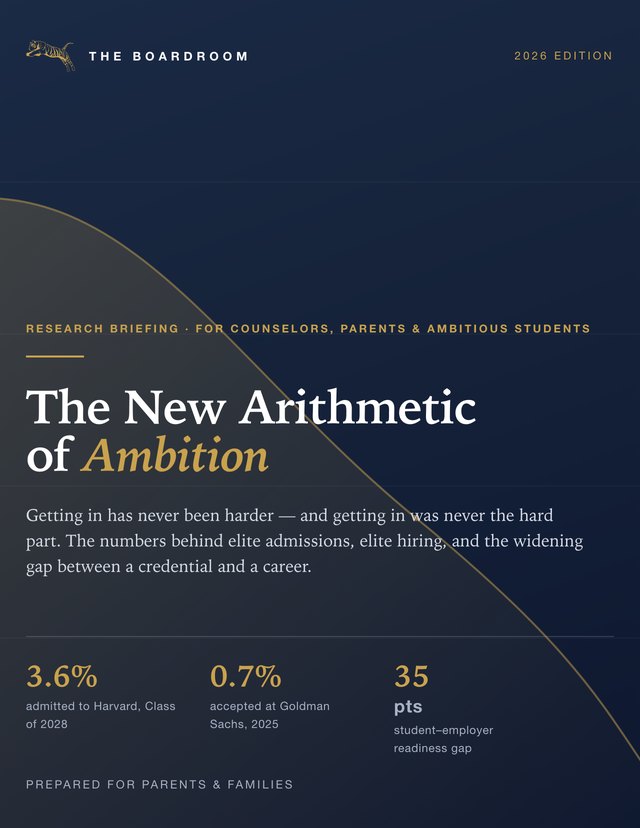
The New Arithmetic of Ambition
We wrote the briefing we wished existed for families — a clear-eyed look at how competitive admissions and hiring have become, why a credential no longer guarantees a career, and what actually prepares a student for the room where decisions get made.
Give your child the edge that gets them in.
By application only, since spots are limited. May 1 deadline.